
Prompt Engineering for Visual Content: Write Briefs, Not Wishes
Guide · 8 February 2026 · Updated 20 November 2026 · 5 min read
In short
Prompt engineering for visual content means writing a brief, not a wish: subject, action, setting, camera, light, colour and emotion, with a lens and a light source in place of words like beautiful or cinematic. Specific decisions remove the model's defaults, which is why two prompts on the same subject return such different results.
Key takeaways
- A visual prompt is a production brief, and every specific word removes an option the model would otherwise choose for you.
- Build in seven steps: the moment, the frame, the light, the palette, the micro-behaviour, the movement, then strip anything a camera cannot use.
- Judgement words like beautiful, epic and 8k carry no shootable information and push every prompt toward the same average look.
- Video needs three extra decisions beyond a still: movement, duration and continuity across shots.
- Change one variable per iteration and keep a written library of winning briefs.
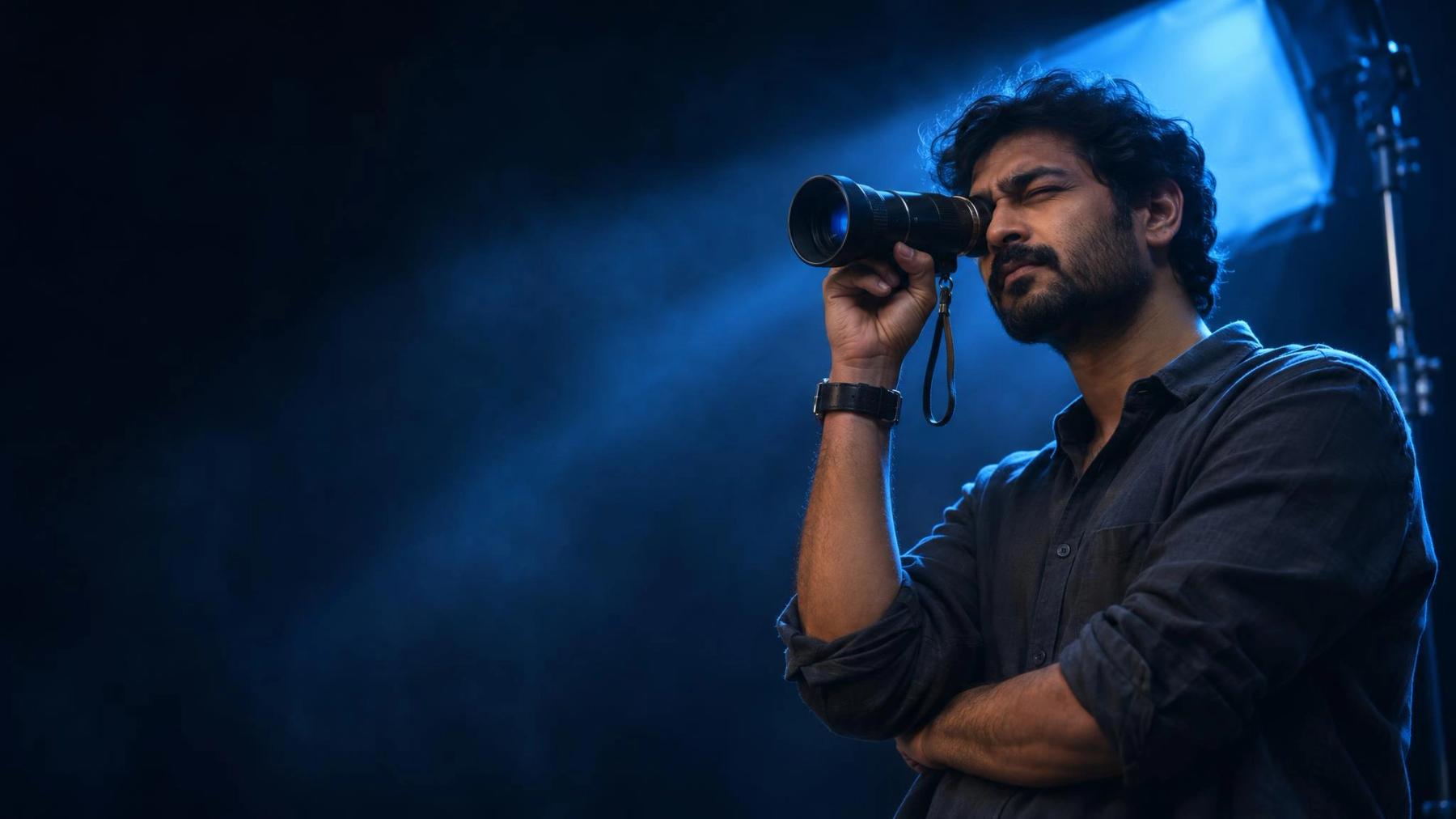
Prompt engineering for visual content is the practice of writing the instruction behind an image or a video as a production brief: subject, action, setting, camera, light, colour, texture, emotion and, for video, sound. Models do not respond to taste. They respond to specifics, and they fill every gap you leave with an average. This guide condenses the method from Prompt DOT AI, the book by X DOT AI founder Da Sachin Sharma.
From prompt to brief
A prompt asks. A brief directs. Compare these two:
- Prompt: "a beautiful woman smiling, cinematic, 8k".
- Brief: "A woman in her sixties gives a trembling smile that does not reach her eyes, soft window light from the left, 85mm close-up, shallow depth of field, muted teal and amber palette."
The first returns the average. The second returns a moment.
Notice what changed. The brief did not add more adjectives, it added decisions. A camera cannot act on "beautiful". It can act on 85mm, window light, left side, shallow focus. Each specific word removes an option the model would otherwise choose for you, and those defaults are what make so much AI imagery look generic.
How do you build a visual prompt from scratch?
Work in this order. The sequence matters more than the wording.
- Write the moment in one plain sentence, with no style words. "A woman hears news she did not want."
- Choose the frame. Distance, angle, lens: close or wide, eye level or low, 85mm or 24mm.
- Place the light. Where it comes from, how soft it is, what colour it is.
- Name the palette and texture. Two or three colours, plus grain, fabric, metal or skin.
- Add the micro-behaviour that carries the emotion: a trembling smile, a held breath, a hand that stops halfway.
- For video, add time. What moves, what stays still, how long the shot holds.
- Strip every word a camera cannot use. If you cannot photograph it, cut it.
Steps one and seven do most of the work. A prompt that opens with a style ("cinematic, hyperreal, 8k") is asking the model to invent the subject for you, and it will invent something ordinary.
In X DOT AI workshops, the exercise starts with "a cinematic shot of a coffee cup". The first rewrite usually adds "moody lighting" and "high detail". It looks better and still means nothing. The rewrite that earns its place reads: "A chipped ceramic cup, half full, cold, on a steel counter, single overhead lamp at 45 degrees, no steam, 50mm at f2, grey morning window behind." Same subject, fewer words, far more control. The difference is not vocabulary, it is the number of decisions.
What structure should an image or video prompt follow?
Eight slots cover almost everything:
- Subject: who or what, with specific detail (age, wear, material, condition).
- Action: what they do, including micro-behaviour.
- Setting: where, when, weather.
- Camera: distance, angle, movement and lens.
- Light: source, direction, quality and colour temperature.
- Colour and texture: a named palette, materials, grain.
- Emotion: the exact feeling, not a generic one.
- Sound, for video: ambience, dialogue, music.
You do not have to fill all eight every time. You do have to know which ones you left out, because the model will fill them with its default. Default light is flattering. Default faces are young. Default framing is centred. Those defaults are why imagery from five unrelated briefs can look like one stock library.
What changes when the output is video?
A still prompt describes a frame. A video prompt describes a shot and the frame inside it, so three more decisions are needed:
- Movement: camera or subject, with one dominant motion per shot.
- Duration and rhythm: how long the shot holds and what changes in that time.
- Continuity: the details that must survive between shots, wardrobe, light direction, the exact shade of a wall.
Take a 15-second product film for a skincare bottle, the kind of brief used on commercial work. The still version lists the bottle, the surface, the light and the palette. The video version adds that the camera pushes in slowly for four seconds, that the label catches the light at the halfway mark, that a hand enters from the right, and that the backlight stays behind the bottle in every shot or the sequence stops cutting together. Sound belongs in the same brief: room tone, no music, one soft click when the cap closes.
That last condition is the one teams forget. Consistency in video is not a model setting, it is the same written decisions applied shot after shot.
Which words weaken a visual prompt?
Words like "beautiful", "epic", "stunning", "masterpiece" and "8k" carry no information a camera can use. Replace each with something shootable: a lens, a light, a colour, a gesture.
- "Beautiful" becomes "soft window light, skin texture visible, no retouching".
- "Epic" becomes "low angle, wide lens, horizon on the lower third".
- "Stunning" becomes "one hard key light, deep shadow on the right side".
- "8k" becomes "fine grain, sharp fabric weave, no digital smoothing".
These are not stronger adjectives. They are instructions a camera and a model can both follow, which is why they survive the render.
Judgement words also cost you variety. Ten prompts containing "stunning" converge on one look, because the model holds one idea of what stunning means and it is not yours.
Why references beat adjectives
When something must look exact, a face, a product, a colour, a style, attach a reference image. Use references for consistency across a series, and words for intent and emotion.
A reference still needs a sentence of brief. Say which property you are borrowing: "same face shape and hairline, ignore the lighting", "this exact blue, ignore the composition". A reference pasted without that line gives the model permission to copy everything, including the parts you did not want. In AI film work the reference usually carries identity while the written brief carries light, lens and mood. Our AI films page shows the kind of work where that split matters.
How should you iterate on a visual prompt?
Change one thing at a time. If the light is wrong, fix the light and keep everything else.
- Name your versions. V1, V2, V3, plus one line on what changed.
- Judge one variable at a time. Change the lens and the palette together and you learn nothing about either.
- Keep the winners. Save the briefs behind your best results; they become your team's library.
- Record the failures too, with the reason. A brief that produced plastic skin is useful information six months later.
Iteration is where the method pays off. The first generation rarely lands, and a tenth attempt with no record of the first nine is simply starting over.
Common mistakes to avoid
- Writing a mood instead of a shot. "Dreamy, ethereal, cinematic" describes a feeling, not a frame.
- Piling on style words to cover a vague subject. No amount of "hyperreal" rescues "a woman".
- Changing five things at once, then not knowing what worked.
- Leaving light unspecified, the fastest route to a flat, average image.
- Reusing a still prompt for a moving shot, then wondering why the subject drifts.
- Treating a lucky result as a method. If you cannot say why it worked, you cannot repeat it.
Teams that want the method built into their own workflow usually start with AI training or a short engagement through AI consulting. The book this guide draws on is listed on the publications page.
Questions people ask
What is prompt engineering for visual content?
It is the practice of writing the instruction behind an image or video as a production brief rather than a wish. You specify subject, action, setting, camera, light, colour and emotion so the model makes fewer choices on your behalf. The goal is a repeatable result, not a lucky one.
How long should a visual prompt be?
Long enough to carry every decision you care about, and no longer. A tight 40 to 60 word brief with a lens, a light source and a specific behaviour usually beats a paragraph of style adjectives. Length is not the measure, the number of shootable decisions is.
Do words like cinematic or 8k actually help?
Rarely. They signal a genre the model already treats as a default, so they push results toward the same average look. Replace them with the thing that would create that impression on set: a lens, a lighting setup, a colour palette, a gesture.
How do I keep a character or product consistent across many images?
Use a reference image for identity and words for light, framing and mood. Add a sentence saying exactly which property to borrow from the reference, and keep the written brief identical across the series except for the variable you are changing.
What is different about prompts for AI video?
Video needs movement, duration and continuity added to the still brief. One dominant motion per shot, a stated shot length, and a written note on which details must stay the same between shots, such as light direction or wardrobe.
Can this method be used by a team without design training?
Yes, which is why it works in organisations. The eight slots and the one-change-at-a-time rule are checkable, so briefs can be reviewed and reused. A shared library of saved briefs does more for consistency than any individual's instinct.
Where does this method come from?
It is condensed from Prompt DOT AI by Da Sachin Sharma, founder of X DOT AI. The book treats prompting as directing, with the prompt as a brief that a camera and a model can both act on.